

118 N Main St, Belmont, NC 28012

Our Blog

girl in the dentist's chair
Categories

Pediatric dentist treating a young child's teeth in the dental chairWhen your child loses a baby tooth earlier than expected, your first instinct might be to simply wait for the permanent tooth to grow in. After all, it can feel like a natural part of growing up. But that open gap in your child’s smile can quietly cause real problems over time if nothing is done to preserve it. Without the right intervention, neighboring teeth can slowly drift into that empty space, leaving little room for the permanent tooth to erupt correctly and potentially setting the stage for alignment issues down the road.

At Main Street Pediatric Dentistry of Belmont, Dr. Matthew Savage takes a prevention-first approach to every child’s dental care. As the only dentist at the practice, Dr. Matthew Savage follows each patient from early childhood through the college years, making consistent and well-informed decisions at every stage. When a baby tooth is lost too soon, space maintainers are one of the most effective tools available for keeping your child’s development on the right path.

What Is a Space Maintainer?

A space maintainer is a dental appliance that holds the gap left behind by a prematurely lost baby tooth. It keeps the neighboring teeth from shifting inward while your child waits for the permanent tooth to come in.

Fixed space maintainers are cemented in place and require no adjustment by the child or parent at home. The type recommended will depend on which tooth was lost, your child’s age and their overall stage of dental development.

Why Early Tooth Loss Matters More Than You Think

Baby teeth do far more than help your child chew and speak. They act as natural guides, holding space in the jaw for the permanent teeth that will follow. When a baby tooth is lost too early, whether from decay, injury, or a dental emergency, the neighboring teeth can shift into the open space. Over time, this narrowing can lead to crowding and misalignment that may require more extensive orthodontic treatment later on.

According to a 2025 systematic review published by the National Institutes of Health, dental space maintainers are highly effective at preventing dental misalignment following the premature loss of primary teeth. Early, proactive care is one of the best investments you can make for your child’s long-term oral health.

Signs Your Child May Need a Space Maintainer

Not every case of early tooth loss calls for a space maintainer but there are several situations where one is strongly recommended. Dr. Matthew Savage will evaluate your child’s specific circumstances, but common indicators include:

  • A baby molar was lost before the permanent tooth was close to erupting
  • The permanent tooth is not expected to grow in for a year or more
  • Neighboring teeth are beginning to shift toward the gap
  • X-rays show that the permanent tooth is still developing and will not emerge soon

A thorough dental exam is the best way to determine whether a space maintainer is the right step for your child. Dr. Matthew Savage will review current X-rays and factor in your child’s age and development before making any recommendations.

What to Expect During Space Maintainer Treatment

Getting a space maintainer placed is a comfortable, low-stress experience for most children. Dr. Matthew Savage takes precise measurements and impressions of your child’s mouth to create an appliance that fits just right.

Many dentists will take an impression of the area using alginate putty, however Dr. Savage uses an intraoral dental scanner. So no more gagging when taking impressions. Kids love it because they can watch the scan of their teeth show up on the computer screen, like magic. Once in place, most kids adapt to it quickly. Routine checkups allow us to monitor the appliance and make sure everything is progressing as it should.

When the permanent tooth begins to emerge on its own, the space maintainer is simply removed. In some cases, a space maintainer may also work alongside early orthodontics to address broader developmental concerns and set your child up for the best possible outcome.

Give Your Child’s Smile the Best Start at Main Street Pediatric Dentistry of Belmont

At Main Street Pediatric Dentistry of Belmont, we believe the decisions made during your child’s early years of dental development have a lasting impact on their smile for life. With over 20 years of experience and board certification in pediatric dentistry, Dr. Matthew Savage brings both the skill and personal attention that growing smiles deserve. As a locally owned and operated practice, your child always sees the same familiar face, building the kind of trust that makes every visit a positive one.

If you are wondering whether your child could benefit from a space maintainer or simply want to stay ahead of any concerns, we would love to hear from you. Contact our office today to schedule an appointment and give your child the thoughtful, prevention-focused dental care they deserve.

Young boy checking his teeth in a mirror with his pediatric dentistIf your child’s teeth seem crowded, their bite looks off, or their upper jaw looks narrow, you may have already been told to “just wait and see.” And sometimes, watching growth over time is the right answer. But there are also situations where waiting too long can make things harder to correct later. A narrow upper jaw, developing crossbite, crowded teeth, mouth breathing, or even regular snoring can all be signs that an early evaluation may be helpful.

These concerns are often easier to evaluate during childhood, while the jaws and facial structures are still growing. At Main Street Pediatric Dentistry of Belmont, Dr. Matthew Savage brings a prevention-first philosophy to every stage of your child’s oral development. With over 20 years of experience and board certification in pediatric dentistry, he is able to identify developing bite, jaw, and growth concerns early and recommend the right next step at the right time. For some children, early orthodontic expansion may be a well-timed way to guide growth before problems become more complex.

What Is Early Orthodontic Expansion?

Early orthodontic expansion, sometimes called palatal expansion, is a form of interceptive orthodontic treatment used to widen a child’s upper jaw. It works by applying gentle, consistent pressure to the two halves of the palate before they fully fuse together.

A device called a palatal expander is placed in the mouth and gradually widens the upper arch over a period of weeks or months. As the palate expands, the goal is to create more room for permanent teeth, improve the way the upper and lower teeth fit together, and support more balanced jaw development.

Why Timing Makes All the Difference

The bones in a child’s jaw do not fully fuse until the early teen years, which means there is a meaningful window during childhood when expansion may be easier and more effective than it would be later, hopefully without surgery or tooth removal. According to the American Association of Orthodontists, all children should be screened by age 7, as this is when there are enough permanent teeth present to detect jaw and alignment issues before they worsen.

That does not mean every child needs treatment at age 7. And it does not mean every 4- or 5-year-old with crowding or snoring needs an expander. But it does mean that early evaluation matters. In some children, concerns such as a narrow jaw, crossbite, crowding, mouth breathing, or regular snoring may be worth looking at even earlier.

Some children benefit from simply being monitored. Some children are best referred to an orthodontist. And some younger children may benefit from early appliance therapy before age 7, especially if there is a narrow upper jaw, crossbite, crowding, early tooth loss, mouth breathing, or airway-related concerns. At Main Street Pediatric Dentistry of Belmont, Dr. Savage can evaluate these concerns early and, when appropriate, provide certain early treatments himself, including space maintainers and palatal expansion for select younger children. The goal is not to rush every child into treatment. The goal is to identify the right child, at the right age, and choose the right next step.

What Snoring, Mouth Breathing, and Airway Have to Do with It

Many parents today are hearing more about airway, sleep, and early orthodontic expansion. If your child snores regularly, sleeps with their mouth open, breathes mostly through their mouth, grinds their teeth, has a very narrow smile, or seems restless during sleep, those are important things to mention during their dental visit.

These signs can have many possible causes, including allergies, enlarged tonsils or adenoids, nasal obstruction, jaw growth patterns, or a narrow palate. A palatal expander does not “fix” every airway problem, and it is not the right answer for every child. But in certain cases, a narrow upper jaw may be part of the bigger picture. This is one reason Dr. Savage likes to evaluate children early. In those cases, Dr. Savage may recommend monitoring, placing an appliance in our office and beginning early expansion treatment, referring to an orthodontist, or coordinating with your child’s pediatrician or ENT.

Signs Your Child May Benefit From Early Expansion

Not every child will need a palatal expander, but there are several signs that an evaluation is worth having. Common indicators include:

  • Upper teeth sitting inside the lower teeth on one or both sides
  • Permanent teeth coming in crowded or overlapping
  • A noticeably narrow upper jaw or narrow smile
  • A high or narrow palate
  • Baby teeth being lost in an irregular pattern
  • Regular snoring, mouth breathing, or sleeping with the mouth open
  • Restless sleep or frequent nighttime waking
  • Difficulty keeping lips comfortably closed at rest

Current dental X-rays and a thorough exam give Dr. Savage a more complete picture of what is happening beneath the surface, including how incoming permanent teeth are positioned and whether the jaw appears to have adequate room for them to erupt properly.

What to Expect During Treatment

When an expander is recommended, the process is gentle and manageable for most children. One nice thing at Main Street Pediatric Dentistry is that Dr. Savage does not have to use that gooey alginate putty to take a mold. Instead, he uses an intraoral digital scanner, kind of like a magic wand. Kids usually think it is pretty cool, and there is no gagging with a mouthful of impression material.

The expansion process typically takes a few months, followed by a retention period to allow the new position to stabilize. Most children adjust to their expander fairly quickly and are able to speak, eat, and go about their days without major disruption. A thorough dental exam and review of your child’s growth history will guide every recommendation. In some cases, early expansion may also work alongside other treatments, such as space maintainers, to help keep all aspects of your child’s development on track.

Give Your Child’s Smile the Best Start at Main Street Pediatric Dentistry of Belmont

At Main Street Pediatric Dentistry of Belmont, we believe that proactive care during childhood creates a foundation that lasts a lifetime. Dr. Matthew Savage is a board-certified pediatric dentist with over 20 years of experience and a genuine commitment to gentle, prevention-focused treatment. As the only dentist at the practice, he knows each child’s history, development and personality, making it possible to identify concerns early and address them thoughtfully.

If you have noticed crowding, a narrow smile, or any bite irregularities in your child, we would love to take a closer look. Contact our office today to schedule an evaluation and find out whether early orthodontic expansion could be the right next step for your child’s smile.

Pediatric dentist providing gentle dental care to a young childFew things matter more to a parent of a child with special needs than knowing the people caring for their child are truly prepared to meet them where they are. Sensory sensitivities, communication differences, and unexpected changes in routine can all make the dental chair feel overwhelming for a child who experiences the world differently. Sounds, unfamiliar smells, bright overhead lights and close proximity to someone new are all factors that can trigger real distress. The good news is that with a provider who is well prepared for these moments, dental visits can become something your child approaches with growing confidence.
At Main Street Pediatric Dentistry of Belmont, Dr. Matthew Savage has built his practice around exactly this kind of care. With 20 years of experience and a genuine passion for working with children of all needs and backgrounds, he brings a calm, patient and adaptive approach to every appointment. Our special needs dentistry services are built on the belief that every child deserves compassionate care tailored to who they are.

What Are Behavior Management Techniques?

Behavior management techniques are a set of strategies pediatric dentists use to help children feel comfortable, safe and in control during dental treatment. Rather than rushing through a procedure, these approaches focus on building trust, reducing anxiety and creating an environment where children can engage at their own pace.

Communication is central to the process, with Dr. Matthew Savage using simple, clear language and a calm, consistent demeanor to help children feel at ease. For children with special needs, these techniques are especially meaningful because they are adaptable, allowing them to respond in real time to what a child is communicating, whether verbally or not.

How These Techniques Make a Difference

Research consistently supports the role of tailored behavior management in helping children have more successful dental visits. A 2022 systematic review published by the National Institutes of Health found that all psychological behavior management techniques studied helped reduce fear and anxiety in pediatric patients. For children with special needs, a carefully matched approach can mean the difference between a visit that feels manageable and one that is distressing for everyone involved.

Approaches We Use in Our Office

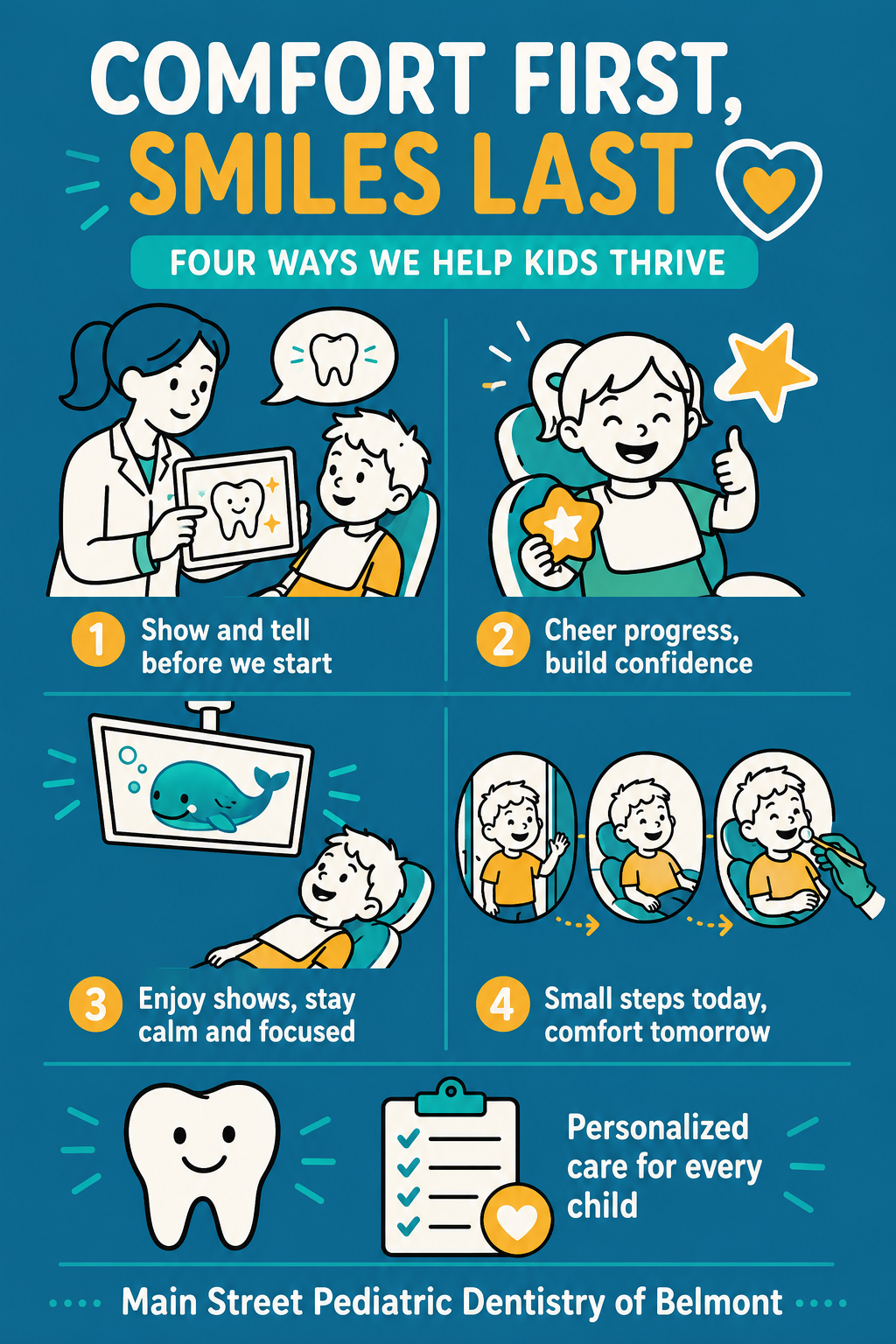
Dr. Matthew Savage draws from a range of evidence-based techniques to meet each child where they are. Depending on the child’s needs, this may include any of the following:

  • Tell-Show-Do: Dr. Matthew Savage explains and demonstrates each step before it happens, reducing the fear of the unknown.
  • Celebrating small wins and cooperative moments helps build confidence over time.
  • Audio-visual tools, including the TVs mounted on our ceiling, give children a positive focal point during treatment.
  • Comfort tours: introducing the dental environment gradually across multiple visits helps children build comfort at their own pace.

No two children are the same and Dr. Matthew Savage takes time to understand each child’s triggers, preferences and comfort level before and during every visit, adjusting the approach as needed to make the experience as positive as possible.

Infographic showing behavior management techniques used in pediatric dentistry for children with special needs

When Sedation Dentistry Offers Additional Support

For some children with special needs, even the most thoughtful behavioral approach may not provide enough support on its own. In these situations, sedation dentistry can provide a safe and effective layer of care, allowing necessary treatment to be completed comfortably and without distress.

Dr. Matthew Savage will always have a thorough conversation with your family about all available options to determine the safest and most appropriate path forward. Laying the right foundation from the first visit makes it easier to build the kind of collaborative, trusting relationship that supports every step of your child’s dental care.

Give Your Child the Compassionate Dental Care They Deserve at Main Street Pediatric Dentistry of Belmont

At Main Street Pediatric Dentistry of Belmont, we believe every child, regardless of their needs or background, deserves a dental experience that feels safe, calm and supportive. Dr. Matthew Savage is a board-certified pediatric dentist with over 20 years of experience and a deep commitment to gentle, individualized care. As the only dentist at the practice, he develops a real relationship with each child over time, which makes a meaningful difference for children who thrive with familiarity and consistency.

If you have a child with special needs and are looking for a dental home where they will be seen, heard and cared for, we would love to connect with your family. Contact our office today to schedule an appointment and let us show you what compassionate, patient-centered pediatric care looks like.

dental office , waiting room

When a cavity shows up at your child’s dental visit, the first thought for many parents is whether that means a drill and a stressful appointment.  For young children especially, the idea of traditional restorative treatment can feel daunting.  Silver diamine fluoride, commonly called SDF, offers a different path, one that stops decay in its tracks without needles, drills, or anesthesia in many cases and it is worth understanding what it is and when it might be the right choice for your child.

At Main Street Pediatric Dentistry of Belmont, Dr. Matthew Savage brings over 20 years of experience and board certification in pediatric dentistry to every appointment.  Our approach to pediatric dental services is built around finding the most comfortable, effective option for each child and SDF is one of the tools that reflects that commitment well.  Here is an honest look at what SDF is, how it works, and where it fits within a complete picture of your child’s oral health.

How Silver Diamine Fluoride Works

SDF is a liquid applied directly to a tooth to stop cavity progression.  It contains silver, which has antimicrobial properties that work against the bacteria driving decay, combined with fluoride applied directly to the tooth surface, which helps strengthen enamel and may reduce the risk of new cavities forming on nearby surfaces. Together, these components can halt active decay and protect the surrounding tooth structure.

A Brief History of SDF

SDF has been used internationally for decades and was cleared by the FDA in the United States as a desensitizing agent in 2014.  In the years since, pediatric dental offices across the country have adopted it as a practical alternative to traditional restorative procedures for young patients.  The application takes only seconds, uses a small brush, and requires no injections, making it well-tolerated even by very young children.

According to data from the National Institute of Dental and Craniofacial Research, tooth decay remains the most prevalent chronic disease in children in the United States, which is why having accessible, non-invasive intervention options matters so much for families.

When SDF Is a Good Fit

SDF is not the right solution for every cavity, but it is a highly practical option in the right circumstances.  Dr. Matthew Savage considers several factors when discussing SDF with families, including:

  • Young children who are not yet ready for traditional dental fillings due to age or dental anxiety, where a quick and comfortable application makes a meaningful difference
  • Primary teeth that will eventually fall out, where stopping decay without drilling is often the most appropriate approach
  • Multiple areas of concern that can be treated in a single, low-stress visit
  • Children with certain health needs who may not tolerate sedation or extended procedures

One thing parents should know before choosing SDF is that it permanently stains treated decay black.  This discoloration is confined to the decayed part of the tooth and does not affect healthy enamel, but being informed going in makes the experience easier for everyone.  

SDF as Part of a Broader Oral Health Plan

SDF works best as part of a broader commitment to children’s dental health rather than as a standalone fix.  Treating an active cavity with SDF addresses the immediate problem, but it does not change the underlying conditions that allowed decay to develop in the first place.  Pairing SDF treatment with consistent cavity prevention habits at home and in the office is what produces lasting results.

Dr. Savage also often recommends dental sealants on permanent molars to protect their chewing surfaces from future decay.  Routine dental exams allow Dr. Matthew Savage to monitor treated areas and catch any new concerns early, keeping your child’s care plan current and effective.  Daily brushing, limiting sugary drinks, and staying on schedule with regular checkups all contribute meaningfully to keeping decay from gaining a foothold.

Schedule a Visit at Main Street Pediatric Dentistry of Belmont

As the sole dentist at Main Street Pediatric Dentistry of Belmont, Dr. Matthew Savage is the consistent, familiar face your child sees at every visit.  That continuity matters for building trust and comfort, and it means treatment plans are thorough and connected rather than fragmented across providers. We are a locally owned practice and we take pride in giving every family clear, honest answers about their options.

If your child is overdue for a checkup or you have questions about tooth decay and what we can do about it, we would love to help. Contact our office to schedule an appointment and let us put together a plan that keeps your child’s smile healthy for the long haul.

Baby chewing on teething ring toy

Your baby is drooling through every outfit, gnawing on anything in reach, and fussier than you have ever seen.  Teething is the obvious explanation, and sometimes it is, but the things teething actually causes and the things it gets wrongly blamed for are very different.  Knowing the difference helps parents respond with confidence rather than worry and steers families away from remedies that can do more harm than good.

At Main Street Pediatric Dentistry of Belmont, Dr. Matthew Savage works with families from the very first tooth through the college years, bringing 20 years of experience and board certification in pediatric dentistry to every visit.  Our pediatric dental services are built around gentle, prevention-focused care that starts early and builds positive associations with the dentist that last a lifetime.  Teething questions come up constantly, and we are always glad to help set the record straight.

What Teething Actually Causes and What It Does Not

Teething gets credited for all kinds of symptoms and it is easy to understand why.  The window when babies cut teeth overlaps with a stage of life when they are naturally more prone to illness and developmental changes.  That timing creates real confusion about what is connected and what is a coincidence.

The Fever Myth

One of the most persistent teething beliefs is that it causes fever, but the research simply does not back that up.  According to the American Academy of Pediatrics, extensive studies show that fever is a false symptom of teething.  A slight rise in body temperature within the normal range may occur as a tooth pushes through, but a true fever signals something else entirely and warrants a call to your child’s doctor.  If your baby runs a temperature above 100.3 degrees Fahrenheit during a teething stretch, that is not teething at work.

The Numbing Gel Myth

Over-the-counter gels containing benzocaine or lidocaine may seem like an easy fix for a fussy, teething baby, but both the FDA and the American Academy of Pediatrics advise strongly against them.  Benzocaine has been linked to methemoglobinemia, a serious condition that affects how red blood cells carry oxygen, and lidocaine carries risks including seizures and severe brain injury in young children.  Dr. Savage recommends safer options include chilled teething rings, a damp washcloth from the freezer, or gentle gum massage with a clean finger.

Facts Worth Knowing About Baby Teeth

Understanding what is actually happening during teething takes a lot of the guesswork out of this stage.  A few things every parent should have on their radar:

  • Most babies cut their first tooth between six and ten months, though the window is wide.  Some babies teethe earlier, and some do not show a first tooth until after their first birthday.  Both fall within normal limits.
  • Primary teeth come in a predictable order, generally starting with the lower front two teeth and progressing outward and upward over the following months.
  • Baby teeth hold space in the jaw and guide incoming permanent teeth into position.  Decay in primary teeth can affect the development of adult teeth, which is why starting dental care before the first tooth is something Dr. Matthew Savage talks with every new family about.
  • The American Academy of Pediatric Dentistry recommends a child’s first dental visit by age one.  Waiting until all the teeth are in means missing the window for early cavity prevention and developmental monitoring.

Once those first teeth arrive, Dr. Savage recommends daily brushing with a toothbrush and routine dental cleanings should begin right away.

When to Reach Out During Teething

Fussiness, drooling, and mild gum tenderness are all normal parts of teething.  A few situations do call for a closer look.  Reach out to your pediatrician if your baby develops a true fever.  Also contact our office if your child shows no sign of a first tooth by 12 months, has prolonged or unusual discomfort, or if anything about how the teeth are coming in looks off.  Our comprehensive dental exams give Dr. Matthew Savage a full picture of how your child’s teeth and gums are developing and allow us to catch anything worth monitoring early.

The goal of early dental visits extends well beyond checking on the teeth coming in.  Dr. Savage talks with families about oral hygiene, diet, habits, trauma, and what healthy development looks like at each stage, building a foundation your child will benefit from for years.

Schedule Your Child’s First Visit at Main Street Pediatric Dentistry of Belmont

Dr. Matthew Savage is a board-certified pediatric dentist and the sole dentist at Main Street Pediatric Dentistry of Belmont which means you and your child sees the same familiar face at every single appointment.  That consistency matters enormously for building the trust and comfort that makes dental visits a positive experience rather than a stressful one.  We are a locally owned practice  and we take genuine pride in the relationships we build with the families we serve.

If your baby’s first tooth has appeared, or you want to get ahead of the curve before it does, we are here to help. Contact our office to schedule your child’s first appointment and give their smile a strong start.

Summer beach concept, chair with ring floating and pineapple on

The school calendar finally clears, backpacks get tucked away, and for the first time in months, your family’s schedule has room to breathe.  That open calendar is one of the most valuable things about summer break and it makes this the ideal time to check off the health appointments that kept getting pushed aside during the busy school year.  When it comes to your child’s smile, a mid-year dental visit during summer is one of the smartest moves a parent can make.

At Main Street Pediatric Dentistry of Belmont, Dr. Matthew Savage and his team have built a prevention-focused, gentle practice around making dental visits a positive experience for kids.  As the sole dentist at the practice, Dr. Matthew Savage is with your child every step of the way, providing consistent, thorough care that supports long-term oral health.  Our pediatric dental services are designed to meet children where they are, from their very first visit all the way through their college years.

No School Schedule Means No Stress

One of the biggest barriers to keeping up with dental visits during the school year is simply the schedule.  Pulling a child out of class, scrambling for an early morning opening, or rearranging afternoon pickups can make even a simple cleaning feel like a logistical challenge. Summer removes all of that friction.

More Time, Calmer Kids

Without the pressure of getting back to school, kids tend to arrive at appointments more relaxed.  There is no rushing, no worry about missing a test and no sense of the day being disrupted.  Dr. Matthew Savage’s gentle approach and behavior management background mean that even children who are nervous about the dentist tend to settle in quickly.  Our dental exams are designed to be thorough and comfortable, building the kind of positive associations with dental care that last well into adulthood.

Families Can Coordinate Easily

Summer also makes it easier to schedule siblings together, reducing the number of separate trips parents need to make.  For families with multiple children, consolidating appointments into one or two summer visits is a practical way to stay current on everyone’s care without the usual school-year juggling act.

Summer Eating Habits Make This a Critical Time to Check In

Summertime tends to bring a shift in what kids eat and drink.  Popsicles, lemonade, sports drinks, and extra snacks work their way into the daily routine, and many of these foods create conditions where cavities can develop more quickly.  A mid-year checkup gives Dr. Matthew Savage a chance to catch any early concerns before they become more involved to treat.

According to data from the Annie E. Casey Foundation, one in four children in the U.S. went without preventive dental care in a recent year, an increase from prior years and nearly one in four kids have teeth that are not in very good or excellent condition.  Staying consistent with summer appointments is one of the most effective ways to keep your child out of that statistic.

A summer visit may include several of the most effective preventive tools available, including:

  • Dental sealants are applied to the chewing surfaces of permanent molars, where decay is most likely to begin.
  • Pediatric fluoride treatment is applied in-office to strengthen enamel and reduce the risk of new cavities forming between visits.
  • A thorough brushing technique review for both kids and parents, tailored to each child’s stage of development.

These preventive steps are quick and painless and can make a meaningful difference in how your child’s teeth hold up through the rest of the year.

Get Ahead of Back-to-School Season

Most back-to-school prep centers on supplies, new shoes, and updated physicals. Oral health deserves a spot on that list, too.  A dental checkup before the academic year begins means any issues get identified and addressed before they have a chance to interfere with school.  Our dental cleanings remove the buildup that daily brushing cannot reach on its own, giving Dr. Matthew Savage a complete picture of how your child’s teeth and gums are developing heading into fall.

Booking during the summer also means more appointment availability.  As the school year ramps up, scheduling windows tend to tighten quickly, so securing a summer slot keeps you ahead of the rush.

Schedule Your Child’s Summer Appointment at Main Street Pediatric Dentistry of Belmont

Dr. Matthew Savage brings over 20 years of experience and board certification in pediatric dentistry to every appointment.  As the only dentist at Main Street Pediatric Dentistry of Belmont, he provides the kind of consistent, personalized care that helps children build genuine comfort with dental visits over time. We are a locally owned and operated practice, and we take pride in knowing our patients and their families.

Summer appointment slots fill up quickly, so the sooner you book, the better your options. Contact our office today to schedule your child’s summer checkup and give their smile the attention it deserves before fall arrives.

Visit Main Street Pediatric Dentistry of Belmont Today

Office Hours:

Monday - Friday: 8:00 AM - 5:00 PM


Saturday: By Appointment Only


Sunday: Closed

Main Street Pediatric Dentistry office